Stud Finders
Best Magnetic Stud Finder
Magnetic stud finders locate metal fasteners in walls, not the studs themselves. Compare three battery-free options, including a pick for plaster and lath.

The RenterSmartHome Research Team, Research desk
Reviews analyzed 13,491 · 10 sources
As an Amazon Associate we earn from qualifying purchases. Affiliate disclosure
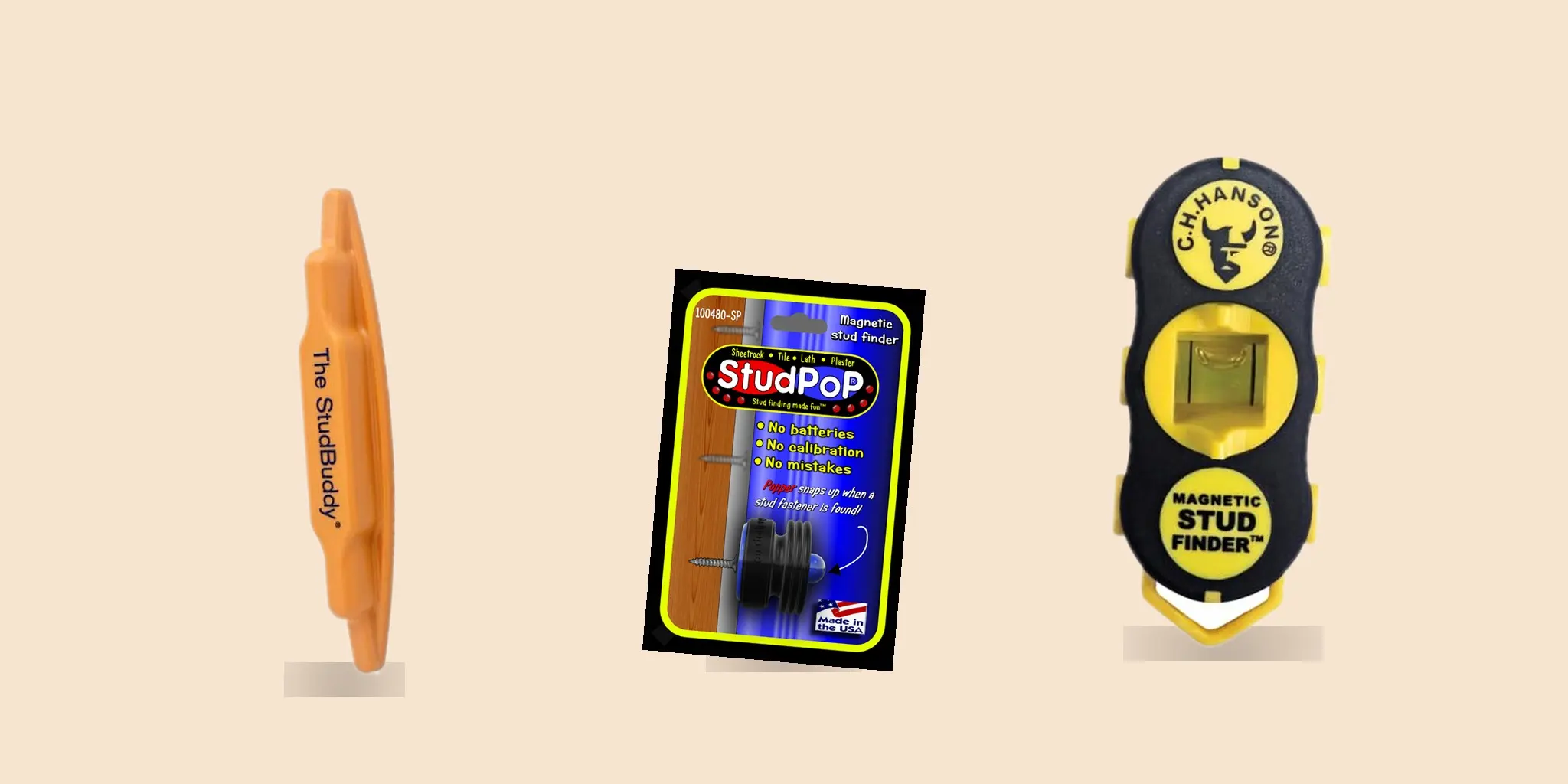
A magnetic stud finder detects ferrous nails or screws in a wall. It does not sense the wood stud itself, so you use the fastener locations to infer where the stud runs. The best magnetic stud finder depends on your wall material and how clearly you want the tool to show a find.
The Original StudBuddy is our pick for straightforward use on suitable drywall. The CH Hanson 3040 adds a built-in bubble level, while the StudPoP is the standout choice for plaster and lath, where the other two can struggle.
These tools need no batteries, but they have limits: they can miss non-ferrous fasteners, and finding a fastener does not tell you whether it sits at the stud's center or edge. For electronic finders on plaster walls, see our guide to the best stud finder for plaster walls. For lower-cost options across finder types, see our best budget stud finder guide.
Our pick
StudBuddy
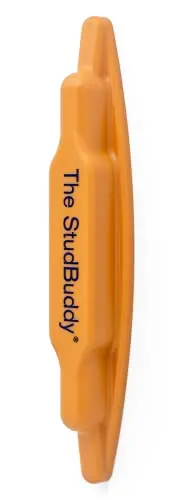
Choose the StudBuddy for a simple, battery-free way to spot ferrous fasteners on suitable drywall.
Not for: Lath-and-plaster or thick plaster walls, or situations where you need a marked center point without estimating.
about $10
See detailsCheck price on AmazonOur pick
StudBuddy
Verdict. Choose the StudBuddy for a simple, battery-free way to spot ferrous fasteners on suitable drywall.
Not for: Lath-and-plaster or thick plaster walls, or situations where you need a marked center point without estimating.
Pros
- Buyers value the strong magnets that hold the tool to the wall hands-free
- Its elongated shape and two magnets cover a wider area and show the fastener's vertical orientation
- The plastic base can glide over painted walls without scratching them
- It needs no batteries or calibration
- Buyers describe it as simple and affordable
Cons
- The manufacturer says it is not intended for lath and plaster, and reviewers report failures on plaster-and-lath walls. One third-party reviewer reported success on plaster and lath, but that conflicts with the manufacturer's guidance
- It has no marking guide or aperture, so precise marking means estimating where the magnet sat
- It detects fasteners, not the stud's center, and cannot detect non-ferrous fasteners such as aluminum
- Review summaries mention noise during use and weaker performance on ceilings
- ASIN
- B00E4690X4
- Price seen
- about $10
- Rating
- 4.4, from an Amazon-mirror spec table
- Review count
- 13,491, from the same Amazon mirror
- Length
- about 6 inches
- Material
- plastic with encapsulated magnets
- Magnet
- N52 neodymium
- Surface field
- 6157 Gauss per magnet
- Pull force
- 16.63 lbs per magnet
- Weight
- 45 g
- Color
- orange
- Batteries
- none required
- Included component
- case
- Made in
- USA
about $10
Check price on Amazon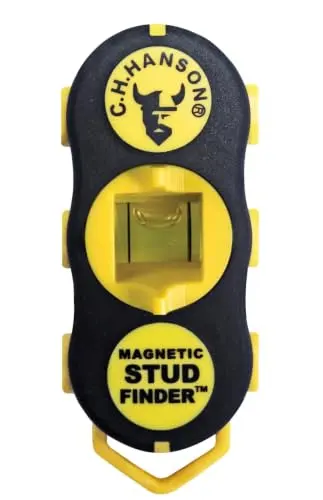
Also worth a look
CH Hanson 3040
Verdict. Choose the CH Hanson 3040 if you want a compact magnetic finder with a basic built-in level.
Not for: Plaster-and-lath walls, or anyone expecting automatic stud-center detection or laser-level precision.
Pros
- Its compact, pocket-size body has a soft grip
- The built-in bubble vial supports level and plumb alignment
- Buyers and retailers describe the magnets as strong enough to hold the tool hands-free
- It needs no batteries
- One reviewer reported finding more than 15 studs in two weeks without a miss
Cons
- Buyers report difficulty on older plaster-and-lath walls, thick drywall, and walls with excessive paint or non-iron fasteners
- It detects fasteners, so you must infer the stud's position
- The bubble vial is a basic level, not a laser
- Its strong magnets can grab other metal tools, making storage less convenient
- ASIN
- B08DY3MKXQ
- Model
- 3040, also listed as 03040
- Price seen
- about $15
- Rating
- unverified
- Review count
- unverified
- Magnets
- rare earth
- Detects
- nails, screws, and steel studs
- Maximum wall thickness
- 3/4 inch
- Level
- built-in rotating bubble vial
- Anchor points
- three on each side
- Dimensions
- about 4.5 inches long by 1.5 inches wide
- Batteries
- none required
about $15
Check price on Amazon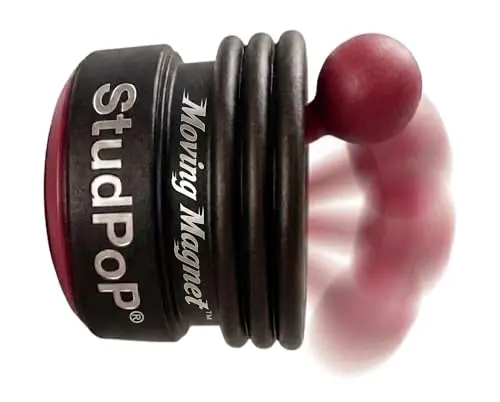
Also worth a look
StudPoP
Verdict. Choose the StudPoP for plaster and lath, where the supplied research identifies it as the standout of these three.
Not for: Anyone who needs a durable-feeling tool, precise stud-center marking, or a finder that detects wires.
Pros
- The pop-up indicator and audible click provide a clear signal when it finds a fastener
- Buyer feedback highlights success on plaster-and-lath walls
- It is listed for use on sheetrock, lath, plaster, and tile
- It needs no batteries or calibration
- An independent reviewer described it as effective at a price under $10
Cons
- An independent reviewer found its plastic base could pick up scratches on textured plaster and become more likely to mark paint
- The all-plastic body was described as feeling inexpensive
- The round design makes precise stud-center pinpointing more difficult
- Its magnetic indications can be subtle on deeper-set nails, and buyer summaries include reports of breakage
- ASIN
- B00FRI5TMY
- Price seen
- about $10, based on a 2024 buy link; current US price unverified
- Rating
- unverified
- Review count
- unverified
- Magnet
- 1-inch diameter moving magnet
- Detection depth
- up to 1/2 inch
- Listed wall materials
- sheetrock, lath, plaster, and tile
- Dimensions
- 5.1 cm high by 20.3 cm long by 15.2 cm wide
- Weight
- 0.03 kg
- Batteries
- none required
- Made in
- USA
about $10
Check price on AmazonHow we picked
We compared three magnetic stud finders using the supplied product specifications, buyer feedback, retailer listings, and independent reviews. We considered ease of locating fasteners, wall compatibility, marking features, and reported drawbacks. Ratings and review counts are included only where verified in the supplied research. We did not hands-on test these products. See our How we research page.
Compare the picks
| Model | Best for | ASIN | Price seen | Rating | Review count | Length | Material | Magnet | Surface field | Pull force | Weight | Color | Batteries | Included component | Made in | Model | Magnets | Detects | Maximum wall thickness | Level | Anchor points | Dimensions | Detection depth | Listed wall materials | Typical price |
|---|---|---|---|---|---|---|---|---|---|---|---|---|---|---|---|---|---|---|---|---|---|---|---|---|---|
| StudBuddy | Our pick | B00E4690X4 | about $10 | 4.4, from an Amazon-mirror spec table | 13,491, from the same Amazon mirror | about 6 inches | plastic with encapsulated magnets | N52 neodymium | 6157 Gauss per magnet | 16.63 lbs per magnet | 45 g | orange | none required | case | USA | n/a | n/a | n/a | n/a | n/a | n/a | n/a | n/a | n/a | about $10 |
| CH Hanson 3040 | Also worth a look | B08DY3MKXQ | about $15 | unverified | unverified | n/a | n/a | n/a | n/a | n/a | n/a | n/a | none required | n/a | n/a | 3040, also listed as 03040 | rare earth | nails, screws, and steel studs | 3/4 inch | built-in rotating bubble vial | three on each side | about 4.5 inches long by 1.5 inches wide | n/a | n/a | about $15 |
| StudPoP | Also worth a look | B00FRI5TMY | about $10, based on a 2024 buy link; current US price unverified | unverified | unverified | n/a | n/a | 1-inch diameter moving magnet | n/a | n/a | 0.03 kg | n/a | none required | n/a | USA | n/a | n/a | n/a | n/a | n/a | n/a | 5.1 cm high by 20.3 cm long by 15.2 cm wide | up to 1/2 inch | sheetrock, lath, plaster, and tile | about $10 |
Why choosing the best magnetic stud finder is tricky
Magnetic stud finders locate metal fasteners, not wooden studs. A find shows where a nail or screw is, but does not prove that it is centered in the stud or reveal the stud's full width. Wall material and fastener type also affect whether a finder responds.
The StudBuddy's manufacturer excludes lath and plaster, while a third-party reviewer reported success on those walls. That report conflicts with the manufacturer's guidance, so it is not a sound reason to choose the StudBuddy for plaster. The supplied reviews instead identify the StudPoP as the better fit for plaster and lath. The CH Hanson 3040 also has reports of trouble on older plaster-and-lath walls.
All three are battery-free. Their differences are in shape, feedback, and extra features: the StudBuddy gives a long visual reference, the CH Hanson adds a bubble level, and the StudPoP signals a find with a moving magnet.
Type comparison
These three magnetic finders use different shapes and signals, but each relies on ferrous fasteners. The StudBuddy uses an elongated body, the CH Hanson pairs magnets with a bubble vial, and the StudPoP uses a moving magnet that pops up and clicks. For a simple finder on suitable drywall, the StudBuddy is the straightforward pick. Choose the CH Hanson if its built-in level is useful for marking a level or plumb line. Choose the StudPoP when plaster and lath is the main concern. None tells you the stud's center automatically, and none detects wires.
What to avoid
A magnetic finder is the wrong choice when the wall lacks detectable ferrous fasteners or when you need the tool to map a stud's full width. Avoid relying on a single magnetic response as proof of a stud center, especially on plaster, thick walls, or surfaces with non-ferrous fasteners. Before buying, match the tool to the wall. The StudBuddy is explicitly not intended for lath and plaster. The CH Hanson has buyer complaints about older plaster-and-lath walls. The StudPoP has the strongest supplied support for plaster and lath, but its base may scratch textured walls and its round shape is less precise for pinpointing. Also avoid treating the built-in CH Hanson bubble vial as a laser, or expecting any of these tools to find wires. If you need a precise center mark or continuous stud tracking, these magnetic options may require more inference than you want.
How to choose
Choose a magnetic stud finder by matching its wall compatibility and feedback style to your task. For suitable drywall and a visible, hands-free reference, pick the StudBuddy. For a basic level, consider the CH Hanson. For plaster and lath, the supplied reviews favor the StudPoP.
Wall material: favor the StudPoP for plaster and lath. Follow the StudBuddy manufacturer's warning against that wall type.
Marking needs: the CH Hanson includes a bubble vial. The StudBuddy and StudPoP do not provide a comparable built-in level.
Signal preference: the StudBuddy can stay on the wall; the StudPoP's magnet pops up and clicks; the CH Hanson requires more technique to feel magnetic resistance.
Fastener limitations: all three depend on detectable metal fasteners and do not identify the stud's center.
Common questions
Do magnetic stud finders find the stud or just the screws?
Magnetic stud finders detect ferrous fasteners such as nails and screws, not the wood stud itself. Use the fastener locations to infer the stud's path, and remember that a fastener may sit off-center. These three models do not tell you the stud's exact edges or center automatically.
Which magnetic stud finder is best for plaster and lath?
The supplied research points to the StudPoP as the standout for plaster and lath, with buyer reports describing success where other magnetic finders struggle. The StudBuddy manufacturer says its tool is not intended for lath and plaster, despite one conflicting third-party report. The CH Hanson also has complaints about older plaster-and-lath walls.
Does the StudBuddy work on plaster walls?
The manufacturer states that the StudBuddy is not intended for lath and plaster, and multiple reviewers report failures on plaster-and-lath walls. One third-party reviewer claimed success on plaster and lath, but that conflicts with the manufacturer's position. For that wall type, the supplied research favors the StudPoP instead.
Can a magnetic stud finder detect wires?
No. The supplied research says the StudPoP does not detect wires, and these magnetic tools are designed to locate metal fasteners. A magnetic response does not indicate whether electrical wiring is nearby, so do not use one as a wire detector or a safety check before drilling.
Do these magnetic stud finders need batteries?
No. The StudBuddy, CH Hanson 3040, and StudPoP all operate without batteries. That makes them ready to use without charging or calibration, but they still depend on finding detectable metal fasteners. If the fastener is too deep, non-ferrous, or absent, the tool may not signal a find.
More in Stud Finders
Sources
- The StudBuddy Magnetic Stud Finder - Desertcart Vanuatu (Amazon listing mirror incl. specs, reviews, Q&A)
- I don't trust drywall anchors, so I tested 12 stud finders - CNN Underscored
- The StudBuddy Magnetic Stud Finder Reviews Summary - ShopWisely
- StudBuddy Plus Magnetic Stud Finder Review - ShopSavvy
- The best stud finders - DigitalTrends
- C.H. Hanson Stud 4 Sure Magnetic Stud Finder - Anderson Lumber (specs, price, Q&A)
- Ch Hanson 03040 Stud 4 Sure Magnetic Stud Finder - Desertcart Oman (user reviews)
- StudPoP Moving Magnet Stud Finder - Want It All (Amazon ASIN B00FRI5TMY in URL; specs, reviews)
- Pop Goes the Stud - StudPop Magnetic Stud Finder Review - HomeFixated
- Studpop Magnetic Stud Finder Review - studfinderreview.com (cons, FAQ)
This guide uses AI-assisted analysis of buyer reviews, manufacturer specifications, and public sources on Reddit, YouTube, and expert sites. A person reviews every guide before it is published. We do not test these tools hands-on. As an Amazon Associate we earn from qualifying purchases. Affiliate disclosure · How we research